kake: The word "菜單" (Chinese for "menu") in various shades of purple. (菜單)
A white porcelain cup on a matching saucer, about two-thirds filled with a clear, honey-coloured green tea.

Apparently I am capable of keeping this thing going! Who knew?

So I now have three months' worth of Chinese menu posts on here, which I think calls for some kind of mini-celebration. I thus decree that August will be dim sum month! I'll be temporarily suspending my character posts to make room for more dish posts — so each week in August, I'll post about two of my favourite dim sum dishes. Also, in honour of the fact that it was the London Perl Mongers who first introduced me to the delights of dim sum, August's "concept" posts will focus on working with Chinese characters in computing contexts.

I thought I'd also take the chance right now to solicit some feedback. I really appreciate all the comments, questions, and corrections that people have been leaving on these posts (or asking me when they see me in real life). I haven't yet put out a call for comments on the series as a whole, though.

So, are there any general questions you'd like to ask me? Is there an aspect of Chinese food that you've always wondered about? Is there a concept, character, or dish that you'd like me to cover? Would you like to see more variation in the types of dish covered, or do you think I've got it about right?

Conversely, are you an expert who's been biting their tongue at all my mistakes? Do you think my quest for good Chinese food outside China is fundamentally doomed? Do you think I'm going about this all entirely wrong? I'm always up for hearing constructive criticism, and I promise to be polite in response.

I'm pretty happy with the way the structure of the series is working out (a concept on Monday, a character on Wednesday, a dish on Friday), but I don't mind hearing any comments or suggestions that you have on that. Also, I've been pondering setting up a more extensive tagging system, and would love to hear any thoughts on that, or indeed on any other ways that I could make it easier for people to find the content they're looking for.

Please do let me know what you think on any of the above — or, if you have no particular thoughts in those directions, just say hello! Or tell me what your favourite Chinese dish is. Or recommend me a Chinese food blog that's worth reading. Or anything else that springs to mind!

And if you happen to be within reach of London during August, and would like to eat some dim sum with me, please drop me an email :)

If you have any questions or corrections, please leave a comment (here's how) and let me know (or email me at kake@earth.li). See my introductory post to the Chinese menu project for what these posts are all about.
kake: The word "菜單" (Chinese for "menu") in various shades of purple. (菜單)
A dish of cooked dark green mangetout leaves garnished with pieces of century egg (皮蛋) and peeled prawns.  The leaves sit in a pool of pale-coloured stock.

上湯豆苗 (shàng tāng dòu miáo) is a basically very simple dish of mangetout leaves moistened with a rich stock, though it can be jazzed up with garnishes such as century egg or peeled prawns (as in the version pictured above, which I ate at Red & Hot in London). English translations I've seen include "pea shoots in rich broth" or simply "pea shoots in soup" [see footnote].

Wikipedia tells me that 上湯 is a "dark tan broth made from Jinhua ham and chicken", while the Red Cook blog states that it's made by adding more fresh meat to an already-made clear stock, and simmering further. The eGullet forums have a nice discussion of Chinese stocks, including a recipe for 上湯. As that recipe points out, it's worth blanching the meat before you begin (I've discussed this beforesee the comments too).

The eGullet recipe also mentions that you should choose an old chicken rather than a young one, for better flavour, and simmer the stock for 6-8 hours. I can thoroughly endorse this suggestion. I bought a "fresh Scottish hen" from the Chinese butcher (he described it as 老雞/lǎo jī/"old chicken") and let the stock simmer at a very low temperature for 8 hours, and it was the chickeniest chicken stock I've ever made. The fact that the neck and feet were also included probably didn't hurt either. The meat itself won't really be worth eating after such a long time — you can eat it if you like (I nibbled a few bits), but the flavour will mostly be gone.

Note that the low temperature is important — if you let the stock boil while you're making it, it will be a creamy/cloudy colour rather than nice and clear. This isn't something specific to Chinese cuisine; in the River Cottage Meat Book, Hugh Fearnley-Whittingstall insists that a stock should never go above "a very gentle simmer, whereby a few bubbles just tremble the surface every few seconds or so".

A word on the dried scallops — these are a very expensive ingredient, and not all that easy to get hold of in the UK. I'm not entirely sure what the situation is regarding these — they're certainly not illegal to sell, since I found them at See Woo in London's Chinatown (at £40 for a 200g gift package of around 25 scallops, and no, that isn't a typo) — but as Helen Yuet Ling Pang points out, they're not often available in the shops. One suggestion given in the eGullet thread linked above is to try substituting them with a bit of dried squid — or you could just leave them out.

Jinhua ham is also not very easy to find — I asked in three Chinatown supermarkets, and none of them had any. Serrano ham or some other dried non-smoked ham might work as a substitute.

Anyway, my stock turned out well, but I shot myself in the foot when it came to making the dish. I couldn't find any pea shoots, so I thought I'd try spinach instead, but accidentally picked up a bag of something that turned out to be labelled "kai choi" — mustard greens (芥菜/jiè cài). Their flavour totally overwhelmed the flavour of the stock, which was a bit disappointing given how long it had taken to make! I'd say this dish is definitely best made with milder-flavoured greens.

The method I used was fairly simple (cribbed from a blend of two recipes, one from Noob Cook and the other from Portion Perfect) — heat oil in a wok over medium heat, add some chopped garlic and stir it around briefly, add the washed leaves and continue to stirfry until they've wilted, pour in some 上湯, season with a drizzle of Shaoxing wine and a small pinch of salt, let it get hot, and serve.

Footnote: [0] I don't actually know why 豆苗 is usually translated as "pea shoots", since to my mind pea shoots look more like this.

If you have any questions or corrections, please leave a comment (here's how) and let me know (or email me at kake@earth.li). See my introductory post to the Chinese menu project for what these posts are all about.
kake: The word "菜單" (Chinese for "menu") in various shades of purple. (菜單)

湯 (tāng) is the Chinese character for soup. It can also mean hot/boiling water.

Soup plays many roles in Chinese cuisines — some sources claim that it's "best drunk on an empty stomach" and "often served just before dinner", others insist that it's "usually served in place of water or tea as an accompanying drink that is supped during the meal", while a book I was reading in the library yesterday afternoon states that "at banquets it is always served last, perhaps in light of the belief that taking too much liquid while eating is not conducive to proper digestion."

Regardless of the point at which it's served, Chinese soup often comes like other Chinese dishes — as a large serving to be divided between all diners, rather than in individual bowls. You'll also see individual soup portions offered on a menu, though; the price is generally a good guide as to whether it's an individual portion or not, or you can look out for the characters 小 (xiǎo/small) and 大 (dà/large).

湯 isn't the only character used to mean soup — there's also 羹 (gēng), which generally refers to a thicker type of soup than 湯. However, I've only ever seen 羹 on one menu so far, as 西湖牛肉羹 (xī xiāng niú ròu gēng), or "West Lake beef soup" (which is both the literal translation and a commonly-used name on English-language menus). 西湘牛肉羹 is a beef soup that's thickened with cornflour and drizzled egg; it also includes fresh coriander and cubed tofu.

Drizzled egg is in fact a common ingredient in Chinese soups. The egg is first beaten, and then added in a thin stream to the simmering soup at the very end of cooking. Either whole eggs or just the whites may be used. These soups are known as 蛋花湯 (dàn huā tāng) in Chinese (literally "egg flower soup") and as "egg drop soup" in American English. I'm not actually aware of a corresponding term in British English! I think we just say "[thing] and egg soup", e.g. "tomato and egg soup" (蕃茄蛋花湯/fán qié dàn huā tāng).

Here are some other soups you may see on a menu:

榨菜肉絲湯zhà cài ròu sī tāngshredded pork and preserved vegetable soup
酸辣湯suān là tānghot and sour soup (note that the Chinese reads "sour and spicy soup", the other way around to the English name)
牛肉麵湯niú ròu miàn tāngbeef noodle soup (interestingly, in Taiwanese cuisine the 湯 is left implicit, so 牛肉麵 means "beef noodle soup" even though there's no "soup" in the name)
豬血豆腐湯zhū xuè dòu fu tāngpig's blood and beancurd soup

You might also see 湯 used in the name of a soft drink — 酸梅湯 (suān méi tāng), or sour plum drink (some info here). This is more of a drink than a soup, really. There's also 上湯 (shàng tāng/consommé/"superior soup"), which I mentioned on Monday and will be posting more about on Friday. Note that 上湯 is an ingredient rather than a dish per se.

Update, March 2011: For further reading, here's an interesting Usenet post on soup in Chinese cuisines.

湯: tāng radical 85 (水/氵/氺) Cantodict MandarinTools YellowBridge Zhongwen

If you have any questions or corrections, please leave a comment (here's how) and let me know (or email me at kake@earth.li). See my introductory post to the Chinese menu project for what these posts are all about.
kake: The word "菜單" (Chinese for "menu") in various shades of purple. (菜單)
An excerpt of a menu reading thus: 蔬菜 - Veg. 空心菜 (清炒, 熗炒, 蒜蓉, 上湯) — Tong cai (plain fried, stir [...]). 芥蘭 (清炒, 蒜蓉, 上湯, 白灼, 蠔油) — Fried Gai-Lan (plain fried, garlic, in soup [...]).

While I've previously had a gentle dig at mix-and-match meat-in-sauce Chinese takeaway dishes, the presence of mix-and-match green vegetable dishes on a Chinese menu is actually a good sign. Generic Anglo-Chinese food often neglects the vegetable side of things, aside from items like "mixed seasonal vegetables" (rarely actually seasonal) and "stirfried beansprouts", but a good Chinese restaurant will offer several green vegetable options, cooked in a number of styles. The Red Cook blog has a nice post on this subject.

Here are some leafy (and other) greens you might see listed on a menu:

豆苗dòu miáomangetout leaves/pea shoots
通菜tōng càiwater spinach/morning glory/ong choy
空心菜kōng xīn càianother name for 通菜
菠菜bō càispinach
菜心cài xīnchoy sum
芥蘭jiè lánChinese broccoli/gai lan
西芥蘭xī jiè lánWestern broccoli/calabrese
冬瓜dōng guāwinter melon
苦瓜kǔ guābitter gourd

You might also see 時菜 (shí cài), which means "seasonal vegetables" — and for completeness' sake, I should also mention 白菜 (bái cài), though given how thoroughly I've already covered this term, I expect regular readers already know more about it than they ever wanted to.

Here are some styles you might see these vegetables offered in:

豉汁/豆豉chǐ zhī/dòu chǐwith black bean sauce
豉汁辣椒chǐ zhī là jiāowith black bean and chilli sauce
蒜泥/蒜茸/蒜蓉suàn ní/suàn róng/suàn róngwith mashed/minced garlic
清炒qīng chǎoplain stirfried
姜汁/姜絲jiāng zhī/jiāng sīwith ginger
上湯shàng tāngin consommé
XO醬XO jiàngwith XO sauce
蠔油háo yóuwith oyster sauce

A few notes on some of these:

Interestingly, the menu pictured at the top of this post offers both 清炒 and 嗆炒 as options, translating the former as "plain fried" and the latter as "stir fried". According to mandarintools.com, 嗆 means "pungent", so I'm not entirely sure what 嗆炒 actually does mean. Update, August 2010: I tried asking about this in the restaurant the menu belongs to, but had a lot of trouble making myself understood. After going around in a few conversational circles I gave up and just ordered some 嗆炒空心菜 — it turned out to be stirfried with dried red chillies and Sichuan peppercorns. Update II, August 2010: I've just noticed I was writing that character wrong — it's 熗, not 嗆. mandarintools.com says 熗 means "to cook in soy". So now I am even more baffled.

If you have any questions or corrections, please leave a comment (here's how) and let me know (or email me at kake@earth.li). See my introductory post to the Chinese menu project for what these posts are all about.
kake: The word "菜單" (Chinese for "menu") in various shades of purple. (菜單)
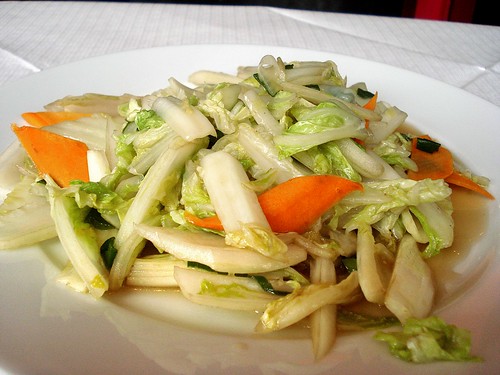
A plate of Chinese leaf/Chinese cabbage cut into bite-size pieces and piled up with a few bits of similarly-cut carrots to provide colour.  A light vinegar sauce coats the vegetables and pools shallowly on the plate.

I had a bit of trouble deciding which English translation to give for the name of this dish. One possible name is "sweet and sour Chinese cabbage", but none of the characters in the Chinese name actually mean "sweet", plus (at least to the British ear) the phrase "sweet and sour" in connection with Chinese food generally conjures up images of terrifyingly red gloopy sauces. The version above is one I ate at Le Wei Xiang in Lewisham, where it was simply listed as "fried Chinese leaves in vinegar". However, in the end I decided to go with the name that Jennifer Miller gives in her beautifully-illustrated post on ordering leafy greens in Chinese restaurants — vinegar-glazed Chinese cabbage.

The Chinese name is 醋溜白菜 (cù liù bái cài). 醋 means "vinegar", and I've already covered 白菜 at some length. 溜 confuses me a little. I've seen it in the names of various other dishes too (e.g. 溜肚片/liù dǔ piàn, which is stir-fried sliced tripe), but CantoDict tells me it means either "slippery" or "rapids" (as in rapidly-flowing water). My paper dictionary says the former meaning is pronounced liū and the latter liù — neither meaning really makes that much sense to me in the context of this dish, so I may be transliterating it wrong. I can't actually remember why I had it down in my notes as liù rather than liū!

醋溜白菜 is a dish that really showcases how well-suited Chinese cookery methods are to vegetables such as leafy greens. Also, it's not only vegetarian, but actually vegan. There are a few variations on the theme, but the basic recipe involves stirfrying the chopped cabbage before adding a simple vinegar/salt/sugar sauce and cooking it down until the cabbage is tender yet still crunchy, and the sauce has reduced to a flavourful glaze. If you want it spicier, you can flavour the initial stirfrying oil with a few dried chillies and/or Sichuan peppercorns, or just add some ground Sichuan pepper at the end of cooking. You could also include a few pieces of carrot for extra colour contrast.

I couldn't find any English-language recipes for 醋溜白菜 on the internet (though I have found some since; see below), but Jennifer was kind enough to translate one of the many Chinese-language recipes available, and send her translation to me to try out and post here. The notes in brackets below are hers, not mine.

醋溜白菜 (Cu Liu Bai Cai - Hot, Sour and Sweet Chinese Cabbage)
Jennifer Miller's translation of a Chinese-language recipe
  • 500g Chinese cabbage
  • 10g vinegar
  • 3g salt
  • 3g MSG
  • 20g sugar
  • 5g green onion
  • 4 dried red chilies
  • 10g water/cornstarch mix (I recommend 1 tsp cornstarch in 1 tbsp water)
  • oil for stir-frying

Separate the leaves of the cabbage and rinse them in water. Cut the leafy parts into smallish slices (I suggest 1 cm). For the stalks, cut into 5 x 3 cm pieces, keeping your knife at a 30 degree angle as you slice (this gives tapered ends to the slices).

Thinly slice the green onions and use your fingers to crumple the dried chilies into small pieces (don't touch your eyes afterward!).

In a small bowl, combine vinegar, salt, sugar, MSG and cornstarch mixture,and set aside.

Coat the bottom of your wok with oil (I suggest 2 tbsp) and heat over medium-high. Add the chilies and fry until fragrant. Add green onions and again fry until fragrant (each of these should take a few seconds, the chilies less than the green onions).

Add the cabbage stalks to the wok and stir-fry until just cooked (literally "until the rawness is broken". I interpret this to mean "tender-crisp"). Add the leaves and again fry until just cooked.

Add the contents of the bowl and raise heat to high. Cook until the sauce clings to the cabbage. Remove from wok and serve.

When I tried this, I left out the MSG (since I didn't have any), and I cut the cabbage as shown in this video. I also used more green onion (spring onion) than it says to in the recipe, because according to my scales 5g is less than half of a spring onion, so I just used the whole thing.

Regarding regionality, Jennifer notes that this is probably a more northern dish than a southern one, "because of the use of bai cai and vinegar, plus the general heartiness of the dish. I couldn't see it coming from the eastern provinces south of Shanghai because those places tend to serve more delicately-flavoured dishes." However, she wants me to point out that this is just coming from her own personal experience, not from any sort of formal research, so if anyone has any opinions on this then we'd both be happy to hear them!

Update, April 2011: Sunflower Food Galore now has a recipe for this dish; Sunflower says that it's from Shandong, a province on the east coast of China which is famous for its vinegar.

Update, May 2011: I've also found a recipe by Savour Asia which uses a different type of cabbage, but it's still the same dish.

If you have any questions or corrections, please leave a comment (here's how) and let me know (or email me at kake@earth.li). See my introductory post to the Chinese menu project for what these posts are all about.
kake: The word "菜單" (Chinese for "menu") in various shades of purple. (菜單)

白 (bái) has a number of related meanings, with the most relevant to the menu context being "white", "pure", and "plain".

Here are some common menu terms that include 白:

白菜bái càibok choy or Chinese leaf (literally "white vegetable" — see my post on 菜/cài)
白肉bái ròuplain boiled pork (see below)
白灼bái zhuóblanched/poached in plain water (see below)
白椒bái jiāowhite pepper
白飯bái fànplain rice (i.e. just boiled or steamed) — you may also see 米飯 (mǐ fàn) used for this

白肉 (bái ròu) is often served as 蒜泥白肉 (suàn ní bái ròu), a pungently garlicky cold dish. Other names I've seen used for this dish are 蒜茸白肉 and 蒜蓉白肉, both of which pinyin-ise as suàn róng bái ròu. 蒜泥白肉 is more common though, in my experience. This really is a tasty dish — thin slices of tender pork coated in a light sauce with an abundance of mashed/minced raw garlic — though you'll stink of garlic for hours afterwards.

白灼 (bái zhuó) confuses me slightly. I've seen it variously translated as "plain braised", "quick boiled" or "quick boiled in soy sauce", "scalded", and "boiled". A thread on the CantoDict forums sheds a little more light — apparently the main characteristic of the 白灼 cooking method is that the items are cooked in water or stock at high rather than low heat (boil rather than simmer). This is perhaps a minor quibble, though — the important thing as far as the diner/menu-reader is concerned is that the item is cooked in liquid rather than fried, baked, etc.

白 is its own radicalKangxi radical 106, which isn't a particularly common one. The only other character with this radical that you're likely to see on a menu is 百 (bǎi/hundred), which as [personal profile] superpitching recently informed me appears in the rather poetic name 牛百葉 (niú bǎi yè, literally "cow's hundred leaves") for third-stomach/omasum beef tripe, also known as leaf or book tripe, a common dim sum dish. I've also seen 百 in the name of another dim sum dish — 百花腐皮卷 (bǎi huā fǔ pí juǎn), which is literally "hundred-flowers beancurd skin rolls" (and is actually stuffed with minced prawns, rather than flowers).

白: bái radical 106 (白) Cantodict MandarinTools YellowBridge Zhongwen

Characters mentioned in this post:
Other related posts:
If you have any questions or corrections, please leave a comment (here's how) and let me know (or email me at kake@earth.li). See my introductory post to the Chinese menu project for what these posts are all about.

kake: The word "菜單" (Chinese for "menu") in various shades of purple. (菜單)

Just a quick one today — I realised that I haven't yet explained how to work out where the tone marks go on pinyin transliterations. First, here's a reminder of what Mandarin tone marks look like and what they mean:

The tone mark always goes on a vowel, never on a consonant. As for which vowel, there's a handy chart on pinyin.info, but essentially it just works like this:

  • If there's an "a" or an "e", it gets the tone mark (you never get both "a" and "e" together in the same syllable).
  • If there's an "ou", the "o" gets the tone mark.
  • In all other cases, the final vowel gets the tone mark.

Simple! I should also note that if you can't type the accents, you can use numbers to indicate tones — for example, guā would be gua1, yú would be yu2, shuǐ would be shui3, and ròu would be rou4. The "fifth tone", or neutral/toneless tone, is written either without a number or as e.g. fu5.

If you have any questions or corrections, please leave a comment and let me know (or email me at kake@earth.li). See here for what these posts are all about.
kake: The word "菜單" (Chinese for "menu") in various shades of purple. (菜單)
A metal pot divided into two halves down the middle with a curved divider.  One side contains 'medicinal' stock, an opaque light-coloured stock with dried mushrooms, shredded spring onions, and dried reddish berries floating in it.  The other side contains a spicier, oilier stock which is almost completely invisible under the layer of dried chillies floating on top.

As with the 水煮 (shuǐ zhǔ) style of cooking, the literal English translation of 火鍋 (huǒ guō) can be somewhat misleading to those unfamiliar with Chinese cuisine. Like 水煮牛肉 (shuǐ zhǔ niú ròu), which is completely different from English boiled beef, 火鍋 bears very little resemblance to Lancashire hotpot.

火鍋 is a sociable, communal-style meal, served as a simmering pot of stock in the middle of the table with raw ingredients (sliced meat and fish, prawns, vegetables, tofu, noodles, etc) supplied on the side. You choose your own ingredients and cook them to your preferred doneness by letting them simmer in the pot before fishing them out with chopsticks or a strainer. Various dipping sauces are also offered.

There are a number of different styles of stock. Helen Yuet Ling Pang describes the Cantonese style, which is a fairly plain one flavoured with carrot, daikon, spring onion, and ginger — you could use pork or chicken stock as a base for this, but since Helen lives with a vegetarian she uses water, and it works out fine. The version pictured at the top of this post is a "split" version known as 鴛鴦 (yuān yāng) [see footnote 0], which has a spicy Sichuan-style stock in one side and a milder, "medicinal" stock in the other — quite handy if the various members of your party have differing chilli tolerances!

I'm having a little trouble finding recipes for the Sichuan-style stock — as far as I can see, a lot of people who make this hotpot style at home simply buy a pre-mixed seasoning packet and use that. I did find a recipe on the BBC website, and an accompanying video [see footnote 1]. (Update, April 2012: I found one on the Yi Reservation blog, though it doesn't give quantities.) I've had no luck at all finding a recipe for the "medicinal" stock, but it usually seems to include things like dried mushrooms and goji berries (wolfberries). (Update, February 2013: Yi Reservation has now posted a recipe for medicinal hotpot stock.)

To serve 火鍋 at home, you'll want some kind of tabletop cooker, a pot to go on it, some small single-serving hotpot strainers, and of course chopsticks. You may want to supply separate sets of chopsticks for eating and for transferring raw ingredients to the pot with, to avoid cross-contamination. Hotpot strainers (photo) should be available in most Chinese supermarkets that have kitchenware sections (regular readers will, I suspect, not be surprised to learn that I got mine from Loon Fung in Silvertown). The cooking can be done in a rice cooker, if you happen to have one of the old types with a completely removable lid, or in a specialist 火鍋 vessel (look for these in any Chinese cash-and-carry/large supermarket). I recently managed to achieve a two-person hotpot in a fondue set, but it was a slow process even on the highest heat setting.

Here are some of my favourite hotpot ingredients (see also my earlier post full of balls):

通菜tōng càiwater spinach (a leafy green with hollow stems and long narrow leaves)
空心菜kōng xīn càianother name for water spinach
金針菇jīn zhēn gūenoki mushrooms (literally "golden needle mushrooms")
凍豆腐dòng dòu dufrozen tofu
大蝦dà xiāking prawns
青口qīng kǒugreen-lip mussels (literally "green mouth")
魚片yú piànsliced fish
特色肥牛tè sè féi niú"characteristic fatty beef" — ultra-thinly-sliced raw beef

Finally, here are some hotpot menus from London restaurants:

Footnote: [0] 鴛 (yuān) and 鴦 (yāng) are the characters for the male and female Mandarin duck, and are often used together to denote a pairing of some kind — CantoDict has a few examples (scroll down).

Footnote: [1] I'm not sure whether or how much the BBC recipe is "dumbed down", given that the chef (Ching-He Huang) is using Lee Kum Kee chilli bean paste — with the brand name blanked out on the jar, since this is the BBC, but the jar is pretty distinctive. See Fuchsia Dunlop on this subject, and also note this forum thread disparaging Lee Kum Kee's pre-prepared Sichuan hotpot base.

If you have any questions or corrections, please leave a comment and let me know (or email me at kake@earth.li). See here for what these posts are all about.
kake: The word "菜單" (Chinese for "menu") in various shades of purple. (菜單)
and

Earlier this week, I posted about less-common menu characters that are still worth learning. One of these characters is 球 (qiú), which literally means ball/sphere/globe.

I first came across 球 in the name of a dish I ate at Dragon Inn in South London — 南乳脆鱔球 (nán rǔ cuì shàn qiú), or crispy eel with red fermented beancurd. 南乳 (literally "southern milk") is the red fermented beancurd, 脆 means "crispy", 鱔 is eel, and 球 is... ball?

However, there are no balls, globes, or spheres in this dish. 球 actually refers to the way that the eel pieces curl up as they're cooked (see photo). It's also sometimes used in the names of prawn (蝦/xiā) dishes, since prawns have a similar tendency to curl. Below are some examples from the menu of Red & Hot near Euston Station in London. The English translations are theirs, not mine — the Chinese names don't specify that king prawns are used in the dish. Note that the dish names would still be intelligible without the 球:

宮保蝦球gōng bǎo xiā qiúgong bao king prawn
魚香蝦球yú xiāng xiā qiúfish-fragrant king prawn
西芹蝦球xī qín xiā qiúsauteed king prawns with celery

While 球 is also used on dim sum menus to mean balls-as-in-meatballs, the character I've most commonly seen used for this on other menus is 丸 (wán). 丸 primarily appears in two contexts: soup (湯/tāng) and ingredients for hotpot (火鍋/huǒ guō). Here are some examples:

魚丸湯yú wán tāngfishball soup
冬瓜丸子湯dōng guā wán zi tāngwinter melon and meatball soup (note the 子/zi here — [personal profile] john sheds some light on this in comments — and also note that the type of ball is not explicitly specified)
牛肉丸niú ròu wánbeef balls
豬肉丸zhū ròu wánpork balls
蟹味丸xiè wèi wáncrab-flavour balls

The last three of these are common ingredients in Chinese hotpot, which is this week's dish post.

球: qiú radical 96 (玉/王) Cantodict MandarinTools YellowBridge Zhongwen
丸: wán radical 3 (丶) Cantodict MandarinTools YellowBridge Zhongwen

If you have any questions or corrections, please leave a comment (here's how) and let me know (or email me at kake@earth.li). See my introductory post to the Chinese menu project for what these posts are all about.
kake: The word "菜單" (Chinese for "menu") in various shades of purple. (菜單)

I currently have a reading vocabulary of around 150 Chinese characters and probably around twice that many words. This is a pretty small number compared to what I'd need to be able to read something in a more general context, but it's enough to read a menu [see footnote].

As I've mentioned before, I've been using Anki to ensure that I don't forget previously-learned characters/words. It works pretty well in that it keeps track of how long it is since it last tested me on a given character, and tries to figure out the best time to test me on it again. However, a few months after I started using it, it gave me an alarming message — one of my characters had been "identified as a leech" and had been "suspended"!

Turns out, what this means is that I kept getting that character wrong, so Anki had decided I was spending a disproportionate amount of time on it and I'd be better off giving up on it for now. This was actually a reasonable assessment for it to make — the character was 房 (fáng), which basically means "house" or "room", and the only reason I'd added it to my vocab list was that it was in the name of a restaurant I'd come across very early on in my learning process, and I thought I may as well stick it in there just in case it turned out to be something I'd come across frequently in the future. It didn't.

However, there are some characters that may not appear very often on menus, but are still useful to know. The way I finally succeeded in learning these characters was to actively seek out names of dishes that included them, and add those dishes to my "Chinese dishes" Anki deck. The more contexts I saw them in, the easier it became to remember them.

I suppose my Anki decks deserve a digression of their own. I have three main ones — Chinese characters/words, Chinese dishes, and easily-confused character pairs. Regarding the dishes deck, I don't indiscriminately add every dish on every new menu I come across — I mainly add dishes if I already know all or most of the characters, or if it's a dish I particularly enjoyed or particularly want to try, or if it's a very common dish. However, I do relax this rule in the case mentioned above — that is, if I can use the dish to help cement a particular character in my head without adding too much of an unnecessary burden (e.g. if there are other "difficult" characters in the dish, it's not going to help).

The Sinosplice blog has a relevant post on this subject, and the followup is worth reading too.

Footnote: [0] When I say I can read a menu, I don't mean in the sense of being able to positively identify each and every dish on a menu I've never seen before — I often can't even do this on non-Chinese menus, as proved in the pub last weekend when I had to use my phone to Google for "agnolotti". I mean in the sense of being able to understand enough of it to order an interesting, varied, and well-balanced meal, and to pick out dishes that I've been meaning to try, rather than panicking and just picking the first thing I recognise.

If you have any questions or corrections, please leave a comment and let me know (or email me at kake@earth.li). See here for what these posts are all about.
kake: The word "菜單" (Chinese for "menu") in various shades of purple. (菜單)
A white plate containing a heap of green beans cooked with sliced red chillies and minced pork.  The skins of the beans are wrinkled and blistered, indicating that as much liquid as possible has been cooked out of them in order to concentrate the flavour.

This week's dish is 乾煸四季豆 (gān biān sì jì dòu), which is usually translated as "dry-fried green beans". As I mentioned on Wednesday, 四季豆 (sì jì dòu) are green beans. 乾 (gān) means "dry", in this context — it also appears on menus as 乾炒 (gān chǎo), most notably as 乾炒牛河 (gān chǎo niú hé/dry-fried beef with ho fun noodles). Note that it may appear in its simplified version, which is 干.

Online dictionaries appear to be quite reluctant to give an English meaning for 煸 (biān), but my paper dictionary translates it as "stir-fry before stewing", which seems reasonable, though to me "stewing" implies there's a fair bit of liquid involved, which is not the case here. This translation does, however, incorporate the idea of twice-cooking, which is what distinguishes 乾煸 from 乾炒.

乾煸四季豆 is a Sichuan dish. Green beans are fried once to cook them through, then drained and fried again with flavourings such as garlic, ginger, chillies, and minced pork. As Beijing Haochi points out (scroll down), the initial frying step softens the beans in a way that's completely different from the result that boiling or steaming would produce — and a commenter on that post notes that this technique bears some resemblance to the multiple cookings of chips/French fries, where the initial one or two steps are intended to cook the potato through, and the final step is intended to give flavour to the outside. Like competently-prepared chips, 乾煸四季豆 isn't overly greasy when executed well, despite the double frying.

Red Cook describes the 乾煸 cooking style as "extreme-heat stir-fry", and notes that since the main ingredient is cooked "to the point of dehydration", its flavour is strongly intensified. 乾煸四季豆 is not a dish for those who hate green beans — the flavour of the beans should be apparent even through the chillies and other strong flavourings.

There are a number of variations of this dish. The Rasa Malaysia version actually deep-fries the beans in the first step — this speeds up the cooking and helps ensure that the beans are cooked evenly. The Appetite For China version omits the pork mince entirely, replacing it with dried shrimp. Other recipes use both pork mince and dried shrimp, for extra complexity of flavour. Some recipes include ground Sichuan pepper, others add chilli bean paste. Some include ginger, while others omit it. Finally, mmm-yoso!!! notes that you can use asparagus instead of green beans for yet another variation.

The version I made for dinner last night included dried chillies, garlic, ginger, preserved vegetable (soaked first to remove some of the saltiness), pork mince, soy sauce, rice wine, ground Sichuan pepper, and a splash of home-made chilli oil. I also added some sliced spring onions at the end, since I like them and happened to have some on hand. It was pretty tasty.

Characters mentioned in this post:
Other related posts:
If you have any questions or corrections, please leave a comment (here's how) and let me know (or email me at kake@earth.li). See my introductory post to the Chinese menu project for what these posts are all about.
kake: The word "菜單" (Chinese for "menu") in various shades of purple. (菜單)

四 (sì) is the character for the number four.

The most common use for 四 on the Chinese menu is perhaps as 四川 (Sìchuān), as in Sichuan food (四川菜/Sìchuān cài) — 四川 literally means "four rivers". 四川 is sometimes abbreviated simply to 川 — note that 四 on its own never means "Sichuan", though.

The next most common is probably as 四季豆 (sì jì dòu), or green beans. The literal translation is "four season beans" — I've read that this is a reference to their being in season all year round.

As noted on Monday, the pronunciation of 四/sì is a little tricky. This YouTube video of a woman cooking 涼拌四季豆 (liáng bàn sì jì dòu, or green bean salad) helps demonstrate the proper pronunciation, since she says 四季豆 quite often towards the start of it!

The radical of 四 is 囗 (wéi/enclosure). At first glance, this looks fairly similar to 口 (kǒu/mouth), which is also a radical. The way to distinguish them is this: when the radical is wéi, the character is basically a box with something in; but when the radical is kǒu, the character will contain one or more empty boxes somewhere within it.

A few examples:

wèi(kǒu radical)flavour/taste — used on menus as e.g. 怪味兔 (guài wèi tù), or "strange-flavour rabbit", a Sichuan dish.
pǐn(kǒu radical)product/commodity — often used on menus to indicate the dessert section, as 甜品 (tián pǐn), literally "sweet things".
huí(wéi radical)revolve/rotate/return — used on menus as 回鍋肉 (huí guō ròu), or twice-cooked pork.

四: radical 31 (囗) Cantodict MandarinTools YellowBridge Zhongwen

Characters mentioned in this post:
If you have any questions or corrections, please leave a comment (here's how) and let me know (or email me at kake@earth.li). See my introductory post to the Chinese menu project for what these posts are all about.
kake: The word "菜單" (Chinese for "menu") in various shades of purple. (菜單)

Last Monday I wrote about tone sandhi, the tone changes that may occur when two syllables come together. Another notable aspect of pronunciation is related to the vowel "i". The "normal" way to pronounce this vowel is as the "ee" in e.g. "bee".

However, "i" is also used to stand for what my textbook tells me is called "the blade-palatal vowel [ʅ]" after the initials "ch", "r", "sh", and "zh", and "the blade-alveolar vowel [ɿ]" after the initials "c", "s", and "z". (According to Wikipedia, the "ee" sound I describe in the previous paragraph is a "close front unrounded vowel".)

This takes us into the realm of phonetics, a subject which fascinates and baffles me in equal measures. Although I have spent hours on the internet trying to find some good examples of people pronouncing the various "i"s mentioned above, somehow I always end up going around in circles.

My textbook says: In pronouncing such symbols as "zhi" and "chi", the tongue is kept still, and care must be taken not to pronounce it as the simple final "i[i]" which is never found after "zh, ch, sh" or "r". (It is silent on the matter of pronouncing e.g. "si".) Wikipedia says: -i is a buzzed continuation of the consonant following z-, c-, s-, zh-, ch-, sh- or r-. In the last resort, as a very rough guide, I suppose I'd say that using an "uh" sound for it instead of an "ee" sound would be an improvement.

As I said in my introductory post, I don't actually speak Mandarin, so I don't plan to go much further into its details than this. However, the double third tone sandhi and the different pronunciations of "i" confused me for ages, so I thought it was worth mentioning them.

(Note added later: In comments, [personal profile] pne points out a couple of slightly more subtle pronunciation variations regarding "e" and "u".)

If you have any questions or corrections, please leave a comment and let me know (or email me at kake@earth.li). See here for what these posts are all about.
kake: The word "kake" written in white fixed-font on a black background. (Default)
Here's the plan: every Friday, let's recommend some people and/or communities to follow on Dreamwidth.

I won't be doing this every Friday, but I just saw [personal profile] rydra_wong's Follow Friday post and figured it was about time I did another one.

Communities:

  • [community profile] 42_answers — answers in search of questions.
  • [community profile] factfinding — where to go when Google fails you.
  • [community profile] transcripts — working together to transcribe videos, podcasts, and visuals, for greater access.

People:

Note to people who're only interested in my Chinese menu posts: see here for how to filter out everything else.
kake: The word "菜單" (Chinese for "menu") in various shades of purple. (菜單)
A deep bowl of sliced beef drowned in a thinnish, spicy sauce with a layer of deep red oil on the top.  Large quantities of chopped dried chillies and fresh chopped garlic are visible, and the dish is garnished with a single sprig of fresh coriander.

As I mentioned on Wednesday, one cooking method that appears frequently on Chinese menus is 水煮 (shuǐ zhǔ), or "water-cooked". It would be a mistake to translate this simply as "boiled", however. The "water" is actually a flavourful, fiery stock enhanced with chilli bean paste (豆瓣醬/dòu bàn jiàng), and the spice level is increased further just before serving with a generous sprinkling of sauteed dried chillies and Sichuan pepper (花椒/huā jiāo).

The main ingredient of the dish might be beef (牛肉/niú ròu), rabbit (兔/tù), sliced pork (肉/ròu piàn), tripe (肚/dǔ), or fish (魚/yú). Because it will be cooked only very briefly (a minute or so), the flesh is sliced thinly, against the grain where applicable. This, along with the choice of simmering rather than stirfrying, helps it stay nice and tender.

Appetite For China has a version of Fuchsia Dunlop's recipe for 水煮牛肉 which I tried out earlier this week. The recipe says to use flank steak. Because I learned to cook roughly a decade before I started eating meat, and hence still have some catching up to do in terms of expertise, I consulted my butcher — he told me that while he didn't have that cut on hand, rump would do nicely, so I bought a pound of that. It worked fine.

Where the recipe says to cut the celery into 2-inch lengths, I think it meant julienne, so that's what I did. It didn't say whether to crush the Sichuan pepper or not — I didn't, and I think I would have liked it a lot better if I had. The numbing flavour only really came out when I was lucky enough to crunch on a peppercorn, and I would have preferred it to be spread more throughout the dish. Also, I was concerned about too much saltiness, which I've found in the past can be a hazard of using chilli bean paste, so I skipped some of the salt in the recipe — I shouldn't have.

As shown in the photo at the top of this post, 水煮牛肉 is basically served as slices of beef swimming in copious amounts of oily, chilli-laded stock. You're not meant to drink all the stock, just lift the beef out and eat that. The recipe linked above uses 3 cups (700ml) of chicken stock for the liquid. I'm not entirely convinced that this much stock is absolutely necessary, and it feels a bit wasteful given that most of the liquid isn't eaten. Bob also mentioned that the flavours seemed to be a bit diluted, and the dish was less oily than when we've had it in restaurants. I may try using a little less stock next time.

Characters mentioned in this post:
Other related posts:
If you have any questions or corrections, please leave a comment (here's how) and let me know (or email me at kake@earth.li). See my introductory post to the Chinese menu project for what these posts are all about.
kake: The word "菜單" (Chinese for "menu") in various shades of purple. (菜單)

This week's character is a nice, simple one — 水 (shuǐ), which means "water" (check out 水 stroke order on Wikimedia Commons for an animated GIF showing how to write it). Like last week's 瓜/guā, it's a radical as well as a character in its own right.

Perhaps the most common occurrence of 水 on the Chinese menu — and indeed the context in which I first encountered it — is as 水煮 (shuǐ zhǔ). Although this translates literally as "water-cooked", the widely-available dishes of 水煮牛肉 (shuǐ zhǔ niú ròu) and 水煮魚片 (shuǐ zhǔ yú piàn) are almost entirely the opposite of what you might expect from "boiled beef" or "boiled fish" — the 水煮 method is actually a deliciously spicy and fiery Sichuan cooking style (of which more on Friday).

Another common use for 水 is in 口水雞 (kǒu shuǐ jī), or "mouthwatering chicken". This is another Sichuan dish, served cold. (Incidentally, if you've seen "saliva chicken" on those wackily-translated not-exactly-perfect-English menus, this is what they mean.) Note that the tone sandhi rule I mentioned on Monday applies to both 口水雞 and 水煮, since they feature two third tones in succession.

The most usual way 水 looks when used as a radical is as three disconnected strokes sticking out from the left-hand side of the character; however, in some fonts these strokes are connected to each other (screenshot). Also, a few characters incorporate the radical in a different way, for example 泰 (tài), which puts it on the bottom rather than on the left, and keeps the standard form rather than transforming it into three strokes. 泰 is short for "Thailand"; you might see it on a menu as, for example, the common dim sum dish of 泰式鳳爪 (tài shì fèng zhǎo), which means Thai-style chicken feet (literally "Thai-style phoenix claws").

Here are some other characters that use 水 as a radical:

zhījuice/sap/gravy; often seen as 姜汁 (jiāng zhī), which indicates that something's in a ginger sauce.
shāsand/granular/powdery; see 金沙玉米 (jīn shā yù mǐ, or "golden sands corn"), and also note that 沙 is used phonetically in 沙爹 (shā diē), which means "satay". Be sure not to confuse it with 炒 (chǎo/stirfried), which is similar but has a different radical.
used alone and as 河粉 (hé fěn) to refer to ho fun noodles.
yóuoil/fat/grease; used as e.g. 紅油 (hóng yóu), meaning chilli oil (literally "red oil").
mashed; e.g. as 蒜泥 (suàn ní), which is mashed garlic.
hǎisea/ocean; most often seen on menus as 海鮮 (hǎi xiān), literally "ocean fresh", meaning seafood, but as [personal profile] john points out in a comment on an earlier post, it also turns up as 上海 (Shànghǎi).
liángcool/cold; commonly seen as 涼菜 (liáng cài), meaning cold dishes such as cucumber salads.
tāngsoup, e.g. 酸辣湯 (suān là tāng) — hot and sour soup.

水: shuǐ radical 85 (水/氵/氺) Cantodict MandarinTools YellowBridge Zhongwen

Characters mentioned in this post:
If you have any questions or corrections, please leave a comment (here's how) and let me know (or email me at kake@earth.li). See my introductory post to the Chinese menu project for what these posts are all about.
kake: The word "菜單" (Chinese for "menu") in various shades of purple. (菜單)

In the first of my "concepts" posts, I briefly mentioned pronunciation, and linked to a couple of videos to demonstrate the four tones of Mandarin:

While I had trouble with the tones at first, I mostly have the hang of them now, in isolation. However! Syllables are not pronounced in isolation. In actual speech, certain changes take place when syllables come together to form words — and note that these phenomena occur in many languages (not just Mandarin) and in many aspects of pronunciation (not just tones).

The way that the tone of a syllable changes depending on its neighbours is known as tone sandhi, and in Mandarin it's governed by a number of rules. Perhaps the most apparent of these to the non-native speaker is the rule that deals with two third tones (falling-rising tones) in succession — the first of these tones becomes a second (rising) tone, and the second of them has its latter (rising) part de-emphasised. This is why the greeting 你好 is pronounced as "ní hǎo" even though the actual pinyin is "nǐ hǎo", and why the "ants" (螞蟻) in ants climbing a tree are pronounced as "má yǐ" rather than "mǎ yǐ". Note that the pinyin spellings remain unchanged, though.

Mandarin has several other tone sandhi rules, and there are a number of pages on the web which list them; here's one with embedded audio examples. The Sinosplice blog also has an interesting post on another way of thinking about Mandarin tones.

If you only want to learn to read menus, you don't actually need to know about this stuff. But I do think it's interesting! Not to mention that being able to pronounce the name of a dish as well as point to it will increase the chances of you actually getting what you intended to order...

If you have any questions or corrections, please leave a comment and let me know (or email me at kake@earth.li). See here for what these posts are all about.
kake: The word "菜單" (Chinese for "menu") in various shades of purple. (菜單)
A dish of diagonally-cut skin-on cucumber pieces piled up on a small plate.  The pieces glisten with a light-coloured oil dressing, and pieces of dried red chilli are tucked in amongst them here and there.

When I first moved beyond Anglo-Chinese takeaway food and started learning about proper Chinese cuisine, one of the many pleasant surprises I had was how tasty and refreshing the cold dishes (涼菜/liáng cài) can be. Indeed, most of the Chinese-language menus I've seen are divided primarily into cold dishes and hot dishes, and these arrive together rather than in strict cold-then-hot sequence. You can even make up an entire meal from cold dishes, if you like; Beijing Haochi has a nicely-illustrated paean to the joys of 涼菜, describing just that.

Certain of my regular dining partners disapprove of my penchant for ordering 黃瓜 (huáng guā/cucumber) dishes in Chinese restaurants, claiming that the markup on these cheap, simply-prepared ingredients is unjustifiable. I do see their point, but I really enjoy the crunch and contrast in amongst the more intensely-flavoured dishes.

There are a number of styles of 涼拌黃瓜 (liáng bàn huáng guā), which literally translates as "cold mixed cucumber". The photo at the top of this post illustrates one I ate at Baozi Inn in Chinatown; the cucumber is stirfried ultra-briefly (10-15 seconds) in oil flavoured with dried red chillies, and marinated with vinegar, sugar, and a few spices. Alice de Jong has a recipe for this style; she calls it 黃瓜皮 (huáng guā pí, literally "thin sheets of cucumber"), while Baozi Inn calls it 炝黃瓜 (qiàng huáng guā), with the 炝 describing the very brief cooking of the cucumber in the flavoured oil.

Another option is the rather fun (and garlicky) 拍黃瓜 (pāi huáng guā), literally "bashed cucumber". It's a bit messy to make (I ended up with cucumber innards in my hair the first time I tried), but also kind of satisfying if you've had a tough day. The basic idea is that you cut the cucumber into wedges and then bash it with the side of a cleaver (or a rolling pin) to break it up and make it easier for the garlicky dressing to soak in. Here are some recipes: Beijing Haochi, Lily's Wai Sek Hong, Planting Bamboos.

I'm also keen on the spicer forms of cucumber dish; the photo below is of the 蒜泥黃瓜 (suàn ní huáng guā) served at Chilli Cool in Bloomsbury; although the name translates simply as "cucumber with mashed garlic", it's spiced up with hot chilli oil and loads of Sichuan pepper. I don't have a recipe for this yet, but I'll certainly be experimenting.

A dish of skin-on cucumber pieces bathed in a dressing of red-coloured chilli oil, with plenty of ground Sichuan pepper.

Recipes for Chinese cucumber salads:

If you have any questions or corrections, please leave a comment (here's how) and let me know (or email me at kake@earth.li). See my introductory post to the Chinese menu project for what these posts are all about.
kake: The word "菜單" (Chinese for "menu") in various shades of purple. (菜單)

瓜 (guā) is the character for "gourd", and is generally used for things in the somewhat hard-to-pronounce Cucurbitaceae family. Like the characters I mentioned on Monday, 瓜 varies in different fonts in a way that really confused me to start with (screenshot). It's worth getting to recognise, though, since not only is it used in its own right in several food-related words, it's also the radical for a few characters including the 瓣 (bàn) of 豆瓣醬 (dòu bàn jiàng) (screenshot).

Here are some ingredients that use 瓜 in the name:

青瓜qīng guācucumber
黃瓜huáng guāanother word for cucumber
矮瓜ǎi guāaubergine (though this term is only used in Cantonese, not in Mandarin — the Mandarin term is 茄子/qié zi — and the menus I've seen are more likely to use 茄子 than 矮瓜)
木瓜mù guāpapaya
南瓜nán guāpumpkin
金瓜jīn guāanother word for pumpkin
苦瓜kǔ guābitter gourd/bitter melon
涼瓜liáng guāanother word for bitter gourd/bitter melon
冬瓜dōng guāwinter melon

As well as the above, [personal profile] superpitching recently discovered another 瓜 vegetable — 勝瓜 (shèng guā), which apparently translates as "sponge gourd", "angled luffa", or "Chinese okra" ([personal profile] pulchritude notes in comments that this is also known as 絲瓜/sī guā). I have never noticed this on a menu, but will be keeping my eyes open from now on, because in my brain a loofah is something you use in the bath, and so I would dearly like to eat one.

瓜: guā radical 97 (瓜) Cantodict MandarinTools YellowBridge Zhongwen

If you have any questions or corrections, please leave a comment and let me know (or email me at kake@earth.li). See here for what these posts are all about.
kake: The word "菜單" (Chinese for "menu") in various shades of purple. (菜單)

Another aspect of reading Chinese characters, which I've previously only mentioned in passing, is the issue of fonts and calligraphy. I'll say upfront that reading cursive/decorative Chinese calligraphy is difficult, and I cannot do it [see sidetrack in footnote]. So I'm going to stick to discussing fonts.

Chapter 12 of Douglas Hofstadter's excellent book Metamagical Themas has a couple of relevant figures (12.3 and 12.4, if you happen to own the book). The first of these shows the Latin letter A in various decorative fonts (the fonts.com website offers a similar set of examples), while the second does exactly the same for the Chinese character 黑 (hēi/black); see my photo of part of the page. The issue Hofstader is exploring with these figures is that of creating a font-making machine that can generate all possible versions of the letter A while also excluding everything that is not an A. However, the figures also serve to illustrate the fact that a reader who is very familiar with a particular set of graphemes (in this case, the Latin alphabet and Chinese characters, respectively) will have a much easier job separating out the decorative flourishes of a particular font from the underlying structural/meaningful parts.

In short: the more practice you get at reading Chinese characters in different fonts, the better you will be at it.

When I started learning to read Chinese menus, I got tripped up a lot by even very simple variations in the way a given character was depicted in different fonts. For example, the character 包 (bāo/package/bundle/bun) has a completely enclosed rectangular area in the centre in some fonts, yet in other fonts this area is open at the left-hand side (screenshot). It took me some time to properly convince myself that it was still the same character. Another one like this is 拌 (bàn/mixed), which in some fonts has the two strokes at the top on the right-hand side pointing inwards at the top, and in other fonts has them pointing outwards at the top (screenshot). Again, it took me some time to recognise these as the same thing.

I can mostly deal with these sorts of variation now, but every so often I still have to check whether a character really is the one I think it might be. I usually do this by pasting it into a Word document and viewing it in a couple of different fonts; the ones I mostly use are 儷宋 Pro and 华文楷体. I have no particular reason for choosing these, just that they happen to be installed on my Mac and they look fairly different from each other.

Relatedly, Chinese-Tools.com has a calligraphy editor that you can use to play around with viewing familiar characters in different fonts (note that the options in section 3 and the final option in section 1 will show you simplified characters rather than traditional ones). Some of these fonts are more like handwriting than printing, but it's still interesting to see the variations.

(Update, July 2013: see also Simon Cozens' post.)

Footnote: I also have more trouble than I should reading things handwritten in English, which is my native language. This is partly because I rarely read handwritten text any more, so I'm out of practice. My own handwriting (example photo) is not actually handwriting as such, since it's not cursive, but rather what we used to call "printing".

If you have any questions or corrections, please leave a comment and let me know (or email me at kake@earth.li). See here for what these posts are all about.

Syndicate

RSS Atom

Tags

December 2012

S M T W T F S
      1
2345678
9101112131415
16171819202122
23242526272829
3031     

Style Credit

Expand Cut Tags

No cut tags