kake: The word "菜單" (Chinese for "menu") in various shades of purple. (菜單)
A very wide and relatively shallow white bowl with a blue pattern around the rim, filled with a reddish-brown soupy sauce with chunks of potato and on-the-bone chicken poking out of it.

The dish I'm posting about today comes from Xinjiang, the region of northwest China that I posted about on Monday.

大盤雞 (dà pán jī) is a Xinjiang dish which translates literally as "a big plate of chicken". This is a pretty good name for it, really — a single order of 大盤雞 (pictured above) feeds at least four people. Some restaurants may offer a smaller portion, 中盤雞 (zhōng pán jī/middle-plate chicken).

I posted an example on Monday of a menu in Xinjiang written in Chinese, English, and Uighur. One of the dishes on this menu is in fact 大盤雞, the Uyghur version of which [personal profile] pne has kindly transcribed for me as داپه‌نجى (he also points out that this is just a transcription of the Chinese name).

I haven't managed to find a single authoritative-looking recipe for 大盤雞 (either in books or online), so please don't rely on the notes below being exactly accurate. The eGullet thread on big-plate chicken has some useful discussion, though.

I found two videos online showing 大盤雞 being prepared. The first was shot in a restaurant in Xinjiang. A whole chicken is cut into chunks on the bone with a cleaver, potatoes are peeled, leeks are prepared, and then various ingredients are shown in bowls, including the chicken, the sliced potatoes, sliced onions, chopped tomatoes, and chopped green chillies (I think). The chicken is initially fried along with a dark red paste from a tub which has a term on it that I can't quite make out, but it's four characters with the middle two being 油 and 豆. The stewing liquid added appears to be water.

The second video is one from 天天飲食, a daily cookery show from China Central Television. The ingredient list given is incomplete, but includes 三黃雞 (sān huáng jī/a type of chicken), 土豆 (tǔ dòu/potatoes), 青紅椒 (qīng hóng jiāo/green and red peppers), 麵粉 (miàn fěn/wheatflour), 朝天椒 (cháo tiān jiāo/"facing heaven" chillies), 乾線椒 (gān xiàn jiāo/some kind of chilli), 花椒粒 (huā jiāo lì/Sichuan peppercorns), 花椒麵 (huā jiāo miàn/ground Sichuan pepper), 紅油 (hóng yóu/chilli oil), 味精 (wèi jīng/MSG), and 鹽 (yán/salt). The chopped-up chicken is blanched in water, some sugar is caramelised, then whole peeled garlic cloves, sliced peeled ginger, and the white parts of spring onions are stirfried in oil. Sichuan peppercorns, star anise, and cassia/cinnamon bark are added and stirfried for a bit longer, then the chicken is returned to the pan along with the caramelised sugar, the two types of chillies, and some salt. Water is added, the chicken is simmered for a while, and then the sliced peeled potatoes are added. The chilli oil and red and green peppers go in later along with a brown powder and what I think is more garlic, chopped this time. The accompanying noodles are made from a simple flour/salt/water dough.

It's worth noting that when I tried making this according to the methods in these videos (and Sunflower's recipe mentioned below), my chicken ended up terribly overcooked. I may have over-fried it in the initial stages, but I do think next time I might give it some time out of the pan while the potatoes are cooking.

Given the large Muslim population in Xinjiang, I was initially confused by the inclusion of beer or Chinese wine in a number of the recipes for 大盤雞 I found online — for example Sunflower's 大盤雞, which uses beer for the stewing liquid. However, [personal profile] sashajwolf points out in comments that beer is not explicitly forbidden in Islam, and arguably neither is wine made from things other than grapes (and the type of Chinese wine used in traditional Chinese cooking is made from rice). [personal profile] pandarus adds in the same comment thread that it's actually intoxication which is forbidden.

The potatoes should be either sliced thickly or cut into chunks. The chicken should be cut into chunks still on the bone — just get the butcher to do this, unless you really love hacking carcasses about with a cleaver. (The chicken pieces should be small enough to be picked up with chopsticks, so you do want it chopped up, not just jointed.)

Garlic, onions, and fresh chillies are commonly mentioned in recipes. Some sources say that tomatoes or tomato purée should go in too, and possibly also some vinegar. Sugar appears in many recipes as well, with Yummy By Scratch even going so far as to caramelise the sugar first. Spices I've seen suggested include cinnamon, cassia, star anise, cumin, Sichuan peppercorns, and dried chillies; Sunflower also adds chilli bean paste (豆瓣醬/dòu bàn jiàng).

As mentioned above, if you're going to order 大盤雞 in a restaurant then you'll need at least four people to do it justice. One good way to eat the dish is to first eat all the chicken and potatoes, then to order some belt noodles (see Sunflower's recipe for how to make the noodles) which are placed in the remainder of the sauce to soak all up. Alternatively, you can soak up the sauce as you go along with the Xinjiang flatbread known as nan. This is similar to the Indian naan (it's leavened, and baked in a tandoor) but is circular rather than teardrop-shaped, and the centre is stamped flat before baking and often impressed with a decorative design (photo of stamped nan).

If you have any questions or corrections, please leave a comment (here's how) and let me know (or email me at kake@earth.li). See my introductory post to the Chinese menu project for what these posts are all about.
kake: The word "菜單" (Chinese for "menu") in various shades of purple. (菜單)

I mentioned 雞 (jī) in my very first ever character post, on 肉 (ròu/meat). As I pointed out there, when you see 肉 on a menu with no further qualification, it almost always means pork, since pork is the default meat in most Chinese cuisines. One exception to this, as mentioned on Monday, is Xinjiang food — 肉 on a Xinjiang menu may well mean lamb, which elsewhere is specified as 羊肉 (yáng ròu).

I'm not aware, however, of any Chinese cuisine in which the default meat is chicken. In my experience, the use of chicken is always signalled explicitly with the character 雞 (jī), which may appear either alone or in combination with 肉 as 雞肉 (jī ròu). Note however that as [identity profile] sung points out in comments, 雞肉 appears very rarely on menus — you normally just see 雞 alone.

You might also see 雞 in combination with 蛋 (dàn/egg), so remember that 雞蛋 is not the meat of a chicken, but the egg of a chicken. As [personal profile] pulchritude mentions in the comments on my 肉 post, 雞蛋 is used instead of 蛋 in situations where 蛋 alone would sound unbalanced.

Finally, note that 田雞 (tían jī), literally "field chicken", is not a chicken, but a frog. You may also see this on menus as 田雞腿 (tián jī tuǐ), or frogs' legs, but often the 腿 is omitted since it's understood that the only part of the frog you generally eat is its legs.

Here are some common chicken dishes:

口水雞kǒu shuǐ jī"mouthwatering chicken", a cold dish of chicken in a spicy sauce
宮保雞丁gōng bǎo jī dīngKung Po chicken (which may come in the original Sichuan style, or a Westernised version)
辣子雞là zi jīfried chicken with chillies; this may also appear as 飄香辣子雞 (piāo xiāng là zi jī/"drifting-fragrance chicken") or 辣子雞丁 (là zi jī dīng), or other variations
糯米雞nuò mǐ jīrice in lotus leaf/lo mai gai, a dim sum dish
怪味雞guài wèi jī"strange-flavour chicken", another cold dish
叫花雞jiào huā jībeggar's chicken — chicken baked whole in a clay (or sometimes dough) coating
醬油滷雞jiàng yóu lǔ jīchicken poached in soy sauce (see 3 Hungry Tummies' recipe)
豉油雞chǐ yóu jīthe Cantonese term for 醬油滷雞 (note that although I give the pinyin here for consistency, the Cantonese would actually be something like si yau gai, or si jau gai)

雞: radical 172 (隹) Cantodict MandarinTools YellowBridge Zhongwen

kake: The word "菜單" (Chinese for "menu") in various shades of purple. (菜單)
Description follows.

[Image: A map of China with Xinjiang shown in red. This is a public-domain image from Wikimedia Commons, originally created by Joowwww.]

While most if not all of the Chinese dishes I've posted about so far come from central/southern/eastern China, there is also some very good food to be had in other areas. Later this week, I'll be discussing a dish from Xinjiang, an autonomous region in the northwest of China, so I thought today I'd give some brief background on the region.

China is a huge country, with many different types of terrain and climate. Although it has a coastline of 14,500 km (9,000 miles) (source: CIA World Factbook), even a relatively central province such as Sichuan is 725 km (450 miles) from the sea at its very closest point, and 1,600 km (1,000 miles) at its furthest (source: Google Maps geocoding). Xinjiang, which borders on countries such as Kazakhstan and Mongolia, is even further away from the sea. In addition to the map above, Wikimedia Commons has a map of China which may help give some perspective on all this.

The vast majority of the land in Xinjiang is uninhabited desert; the population is found in the mountains and in oases around the edges of the deserts. The staple food is not rice, but wheat products such as bread and noodles. Commonly-used flavourings include cumin and other fragrant spices.

Xinjiang has a significant Muslim population, so you won't find the predominance of pork dishes here that you would in other Chinese cuisines [see footnote]. Instead, the main food animals are sheep and goats, though other animals such as chickens are also eaten. Typical dishes include laghman (handpulled noodles with a lamb-based sauce), big-plate chicken (a stew of chicken and potatoes), flatbreads, lamb grilled on skewers, and samsa (lamb-stuffed pastries similar to samosas). Rice is reserved for festive dishes such as pulao, a dish based on rice flavoured with meat and vegetables.

According to Wikipedia, the majority population of Xinjiang at the 2000 census was Uyghur (sometimes spelt "Uighur"), with Han Chinese coming a close second. Hence, while Mandarin is widely used in Xinjiang, so is the Uyghur language, which is a Turkic language (as opposed to the Sino-Tibetan Mandarin) written in an alphabet derived from Arabic. Here's an example of a menu from Xinjiang written in Chinese, English, and Uyghur. For the same reason, you may see the food of the region referred to as Xinjiang food (新疆菜/Xīnjiāng cài), Uyghur food, or sometimes Chinese Muslim food (though the latter is a broader term).

Uyghur food is not found only within Xinjiang; according to Beyond the Great Wall by Jeffrey Alford and Naomi Dugiud, Uyghur restaurants and street food stalls are common in central China, and [personal profile] pinetree notes in comments that in fact Xinjiang food is now found all over China. Even London now has a Xinjiang restaurant — Silk Road in Camberwell.

For more on the food of Xinjiang, see Fuchsia Dunlop's Gourmet article on the subject and two Life On Nanchang Lu posts: food seen and eaten on a trip to Xinjiang, and ten must-try Uyghur foods.

Footnote: [0] Indeed, while in most regions of China the character 肉 (ròu, literally "meat") is taken in the absence of further qualification to mean pork, you can't necessarily assume that this is the case on a Xinjiang menu; here's a photo of part of the menu at Silk Road, which simply uses 肉 to indicate a lamb dish, rather than 羊肉 (yáng ròu/sheep/lamb). I'm not entirely sure how widespread this practice is, however.

If you have any questions or corrections, please leave a comment (here's how) and let me know (or email me at kake@earth.li). See my introductory post to the Chinese menu project for what these posts are all about.
kake: The word "菜單" (Chinese for "menu") in various shades of purple. (菜單)
A bowl of soft wheat noodles almost completely hidden under garnishes of beansprouts and julienned cucumber.  A dollop of dark brown bean-based sauce is in the middle.

While the literal translation of 炸醬麵 (zhà jiàng miàn) is "fried sauce noodles", perhaps a more useful one would be "noodles with meat sauce". Other translations I've seen include "noodles Peking style" (at Le Wei Xiang) and "Beijing pork noodles" (at Baozi Inn, whose version is pictured above). It's a simple dish of plain noodles topped with a rich sauce based on pork mince fried with one or more types of bean sauce. It's usually presented as shown above, with the sauce and garnishes laid out neatly on top of the noodles, and you mix it all up together before eating it.

The observant may note that this bears some resemblance to the Western spaghetti bolognese and the Korean ja jang myeon. Indeed, ja jang myeon is descended from 炸醬麵. Similarly, just as a simplified version of spaghetti bolognese is a popular student dish, so is 炸醬麵 — it's quick to make, uses inexpensive ingredients, and can be customised to suit the ingredients you have on hand.

While as mentioned above "noodles with meat sauce" is a reasonable translation, another possible option would be "noodles with bean sauce", due to the thick bean-based sauces used to give flavour and body. Sunflower's 炸醬麵 recipe uses sweet bean paste (甜麵醬/tián miàn jiàng) and chilli bean paste (豆瓣醬/dòu bàn jiàng), while the 炸醬麵 recipe at Tigers & Strawberries adds a third sauce, described as "soy bean sauce" — the author tells me via email that this is similar to yellow bean sauce (黃醬/huáng jiàng). Hoisin sauce (海鮮醬/hǎi xiān jiàng) could also be used as a secondary flavouring. The 3 Hungry Tummies version includes Sichuan pepper, too, for extra bite.

Although the noodles and sauce alone make a perfectly good dish, for me the important finishing touch is the vegetable "garnishes" which are mixed in with the sauce and noodles just before serving. These might include raw slivered carrots and cucumber, raw or lightly blanched beansprouts, blanched shredded cabbage, shredded thin omelette, and so on. (See also Beijing Haochi's description of perhaps the ultimate version of this.)

Recipes for 炸醬麵:

If you have any questions or corrections, please leave a comment (here's how) and let me know (or email me at kake@earth.li). See my introductory post to the Chinese menu project for what these posts are all about.
kake: The word "菜單" (Chinese for "menu") in various shades of purple. (菜單)

醬 (jiàng) isn't a character that generally appears standalone — on a Chinese menu, it's almost always part of a word. It essentially denotes some kind of jam-like or paste-like food, and is often translated as "sauce" or "paste".

The radical of 醬 is 酉 (yǒu/wine); note that it appears on the bottom of the character, rather than on the left as in most other characters with this radical. Characters with the 酉 radical are usually associated with alcohol or fermentation in some way, which certainly fits with 醬, as many Chinese pastes/sauces involve fermentation.

Here are some types of 醬 you might see mentioned on a menu, or used in a recipe:

豆瓣醬dòu bàn jiàngchilli bean paste
海鮮醬hǎi xiān jiànghoisin sauce (literally "seafood sauce")
沙爹醬/沙嗲醬shā diē jiàngsatay sauce (transliteration)
沙茶醬shā chá jiàngshacha sauce
醬油jiàng yóusoy sauce [see footnote]
XO醬XO jiàngXO sauce
黃醬
or 黄豆酱
or 磨豉醬
huáng jiàng
or huáng dòu jiàng
or mó chǐ jiàng
yellow bean sauce

And here are some specific dishes that use the character 醬:

醬牛肉jiàng niú ròubeef braised in soy sauce then sliced and served cold (see Su-Lin's post on 醬牛肉)
炸醬麵zhà jiàng miànnoodles with pork and fermented bean sauce, literally "fried sauce noodles" (see my post on 炸醬麵)
XO醬煎腸粉XO jiàng jiān cháng fěngrilled cheung fun with XO sauce
京醬肉絲jīng jiàng ròu sīshredded pork in Peking sauce (a sort of sweet bean-based sauce)

醬 is also used in the Chinese names of various Western sauces/condiments such as peanut butter, mayonnaise, etc — see the CantoDict entry for 醬 for a list.

Footnote: [0] [identity profile] sung points out in comments that the Cantonese term for soy sauce is different: 豉油 (si-yau) is the term used for soy in general and 生抽 (san-cao) for light soy and 老抽 (lao-cao) for dark soy.

醬: jiàng radical 164 (酉) Cantodict MandarinTools YellowBridge Zhongwen

If you have any questions or corrections, please leave a comment (here's how) and let me know (or email me at kake@earth.li). See my introductory post to the Chinese menu project for what these posts are all about.
kake: The word "菜單" (Chinese for "menu") in various shades of purple. (菜單)

A very quick post today — I've been away for a long weekend, so I'm behind on everything and don't have the energy to write much!

I'm compiling a list of places to buy Chinese ingredients online. Does anyone have any personal recommendations? I'm in the UK, but I'm also interested in places that will deliver elsewhere.

If you have any questions or corrections, please leave a comment (here's how) and let me know (or email me at kake@earth.li). See my introductory post to the Chinese menu project for what these posts are all about.
kake: The word "菜單" (Chinese for "menu") in various shades of purple. (菜單)

One particularly tasty type of Chinese mushroom is 茶樹菇 (chá shù gū), also known as tea tree mushroom or Agrocybe aegerita. I posted about 菇 (gū/mushroom) earlier this week, and have also previously posted about 茶 (chá/tea). 樹 (shù/tree) frequently appears on menus in the form of 螞蟻上樹 (mǎ yǐ shàng shù), or "ants climbing a tree".

Although tea tree mushrooms are available fresh in some parts of the world, I've only ever seen them dried in London (at New Loon Moon in Chinatown). The dried ones are still tasty, though the stems of the larger ones can be a bit hard even after soaking — one tip I've heard for using up the tougher stems is to pop them in a bag in the freezer and throw them in next time you make stock, for a bit of extra flavour.

茶樹菇 are good in soup, in stir-fried dishes, and in 火鍋 (huǒ guō/hotpot/steamboat) (photo of some prepared for hotpot). Pictured above is a rather good stirfry of 茶樹菇 and 臘肉 (là ròu/Chinese ham) that I ate at Chilli Cool in Bloomsbury and later tried to recreate at home.

I based my attempt on a recipe from Beijing Haochi, though I left out the greens as I was doing a separate leafy greens dish in the same meal. There was plenty of flavour from the mushrooms and ham alone, but I did also add a bit of Shaoxing wine and soy sauce.

I didn't use an expensive ham — I've tried finding Yunnan ham in London, but as yet have had no success, so I just used some cheap 臘肉 that I found at Loon Fung in Silvertown. If you feel adventurous, you could also try making your own!

If you have any questions or corrections, please leave a comment (here's how) and let me know (or email me at kake@earth.li). See my introductory post to the Chinese menu project for what these posts are all about.
kake: The word "菜單" (Chinese for "menu") in various shades of purple. (菜單)

菇 (gū) is the Chinese character for mushroom. It doesn't cover all types of fungi — for example, wood ears/tree ears/black fungus would be 木耳 (mù ěr, literally "wood ear") — but it does cover a number of species that are commonly used in Chinese food.

Here are some types of mushrooms you might see on a menu:

香菇xiāng gūChinese black mushrooms (shiitake mushrooms, literally "fragrant mushrooms")
冬菇dōng gūanother name for the above (literally "winter mushrooms")
huā gūhigh-quality shiitake mushrooms (literally "flower mushrooms", referring to the crackled top pattern that appears on the good quality ones — photo)
北菇běi gūdried shiitake mushrooms
金菇jīn gūenoki mushrooms (literally "golden mushrooms")
金針菇jīn zhēn gūanother name for the above (針/zhēn, which means "needle/pin", refers to their shape)
樹菇chá shù gūtea tree mushrooms

And here are some dishes with 菇 in the name:

茶樹菇炒臘肉chá shù gū chǎo là ròustirfried tea tree mushrooms with Chinese ham
茶樹菇炒豬舌chá shù gū chǎo zhū shéstirfried tea tree mushrooms with pig's tongue
香菇雞飽仔xiāng gū jī bǎo zisteamed buns stuffed with chicken and shiitake mushrooms
臘味冬菇雞飯là wèi dōng gū jī fànrice with preserved meat, chicken, and shiitake mushrooms
香菇帶子腸粉xiāng gū dài zi cháng fěncheung fun with scallops and shiitake mushrooms
香菇雞絲粥xiāng gū jī sī zhǒucongee with shiitake mushrooms and shredded chicken
蠔油三菇háo yóu sān gūthree types of mushroom in oyster sauce

NB: this week's dish post will be up tomorrow rather than Friday, since I'm off to Glasgow for a long weekend and won't be taking my laptop.

菇: radical 140 (艸/艹) Cantodict MandarinTools YellowBridge Zhongwen

If you have any questions or corrections, please leave a comment (here's how) and let me know (or email me at kake@earth.li). See my introductory post to the Chinese menu project for what these posts are all about.
kake: The word "菜單" (Chinese for "menu") in various shades of purple. (菜單)

I'm back from my month off, and have lots of interesting things to post about — but for today, I'm just going to put up this index of all the dishes I've posted about so far, to go with the subject index I posted a month or so ago. Please do let me know if you think there's a better way to organise it.

I'll be keeping this up to date as I write about more dishes, and it's also linked in the sidebar.

Skip to: dishes by main ingredient | dishes by other interesting ingredients | cold dishes | dim sum | vegan and veganisable dishes | specific cooking techniques | dishes not otherwise categorised.

Dishes by main ingredient

Dishes using other interesting ingredients

Cold dishes (涼菜/liáng cài)

Dim sum (點心/diǎn xīn)

Vegan and veganisable dishes

Note that I've only included here dishes that I think are just as good in the vegan versions as they are in the meaty ones. For example, I don't feel that 擔擔麵 actually needs the pork mince, but 乾煸四季豆 wouldn't be the same without it. Obviously, this is subjective. Another point worth noting is that you will need a good (preferably home-made) vegetable stock to use in place of the chicken/pork stock that flavours many of these dishes, and you may find that the texture is more watery than it should be due to lack of gelatin — this latter point also applies to the meaty versions, if you're using e.g. stock cubes instead of proper stock.

Posts which mention specific cooking techniques

Dish posts not otherwise categorised


If you have any questions or corrections, please leave a comment (here's how) and let me know (or email me at kake@earth.li). See my introductory post to the Chinese menu project for what these posts are all about.
kake: The word "菜單" (Chinese for "menu") in various shades of purple. (菜單)
A white ceramic mortar with ridged, sloping sides and a brown border around the top.  The bowl is half-filled with a puree of steamed peeled aubergine, in which rests a smooth wooden pestle.  A few large slices of grilled green pepper are also visible.

As I mentioned yesterday in my post on 茄子 (qié zi), aubergine/eggplant is my favourite vegetable. I love it baked, fried, barbecued, steamed, stewed, curried, puréed, whatever. I particularly love it in the form of baba ganoush, a Middle-Eastern dish where the aubergine is roasted until the skin blackens, then peeled and mashed with tahini, garlic, lemon juice, and salt.

Given this, I was highly intrigued by the dish pictured above, which I ate at Golden Day in London's Chinatown. It's roughly-speaking a Chinese version of the same thing — 擂蒸茄子 (lēi zhēng qié zi), or steamed, peeled aubergine mashed up with various flavourings in a large pestle and mortar. 擂 (lēi) is the only character here that I haven't posted about before; it means "grind" or "pound". 蒸 (zhēng) means "steamed", while 茄子 (qié zi) means "aubergine".

I don't have a recipe for the specific dish we tried at Golden Day, but I can recommend Viet World Kitchen's recipe for spicy Hmong eggplant, which is reasonably similar and very tasty. Moreover, it's not only vegetarian but also vegan, which fits in nicely with the fact that today is World Vegetarian Day.


And with that, I sign off for a month. As I said previously, I'll still be around reading and commenting on other people's blogs, and I'm always available at kake@earth.li if you have any questions, comments, dinner invitations, or desire to hang out with me in the pub — but my next post here will be on 1 November.

If you have any questions or corrections, please leave a comment (here's how) and let me know (or email me at kake@earth.li). See my introductory post to the Chinese menu project for what these posts are all about.
kake: The word "菜單" (Chinese for "menu") in various shades of purple. (菜單)

According to my vocab lists, 茄 (qié) was one of the very earliest Chinese characters I ever learned; this doesn't really surprise me, since it's the character for my favourite vegetable — the aubergine, or eggplant.

There are a few other characters that 茄 often appears on menus in company with: 子 (zǐ), 條 (tiáo), and 蕃/番 (fān). I wondered if perhaps 茄子 was an emphasis of the egg-like nature of the aubergine, since one of the meanings of 子 is "seed" or "egg", but [personal profile] pne has commented with a more informed view — he says the 子 is probably being used as a mostly-meaningless suffix to disambiguate it from similarly-pronounced characters and/or to make the one character into a proper "word" (which often have two characters). 茄條 usually means that the aubergines are cut into strips — 條 refers to a long, narrow piece of something.

番茄/蕃茄, on the other hand, doesn't mean "aubergine", but "tomato". I don't know the etymology of this, but [personal profile] pne proposes in the same comment that it might be "barbarian's eggplant", since one of the older meanings of 番 is "barbarian", i.e. someone not Chinese (perhaps a politer translation might be "foreigner's eggplant"). Note that 蕃 is just 番 with a grass radical (艹) on top — I've seen both spellings in roughly equal proportions.

Here are some dishes with 茄 in the name:

魚香茄子yú xiāng qié zifish-fragrant aubergine
紅燒茄子hóng shāo qié zired-cooked aubergine
雙椒茄子shuāng jiāo qié ziaubergine with green and red chillies (雙椒 is literally "double peppers")
老干媽茄子Lǎo Gān Mā qié ziaubergine with Lao Gan Ma chilli sauce
家常茄子jiā cháng qié zi"home-style" aubergine
蕃茄炒蛋fān qié chǎo dànstirfried egg with tomato

Another term for aubergine is 矮瓜 (ǎi guā), which literally translates as "short gourd". As mentioned in the comments on that post, though, I've only ever seen 矮瓜 on one menu — 茄子 is much more common.

[identity profile] sung also points out in comments that the northern Chinese term for tomato is 西紅柿 (xī hóng shì), which translates literally as "western red persimmon". 蕃茄/番茄 is a more southern term.

茄: qié radical 140 (艸/艹) Cantodict MandarinTools YellowBridge Zhongwen

If you have any questions or corrections, please leave a comment (here's how) and let me know (or email me at kake@earth.li). See my introductory post to the Chinese menu project for what these posts are all about.
kake: The word "菜單" (Chinese for "menu") in various shades of purple. (菜單)

Since I'm taking October off for research purposes, I thought now would be a good time to have a go at making a subject index of all my Chinese menu posts so far, to make it easier for people (including me) to find things. I'd welcome any comments and suggestions regarding ways of making this easier to use. Update, April 2011: I now have a dish index and a character index as well.

Meta (posts about these posts)

Subtypes of Chinese food

Regions of China

Specific ingredients

In the restaurant

Mandarin Chinese basics

Chinese culture

Looking things up

Practising

Computer-related stuff

If you have any questions or corrections, please leave a comment (here's how) and let me know (or email me at kake@earth.li). See my introductory post to the Chinese menu project for what these posts are all about.
kake: The word "菜單" (Chinese for "menu") in various shades of purple. (菜單)

I think I may have mentioned this before, but one very useful type of resource in learning to read Chinese menus is the English-language Chinese food blog, particularly those which include the Chinese names of dishes and ingredients.

Here are a few examples of the kind of blogs I find useful — I would love to hear of any others that people can recommend.

I'm mainly looking for sources that I can trust to know what they're talking about (and are willing to admit when they aren't sure about something), and that discuss the history and context of the food rather than just posting recipes. Have you got any good suggestions for me?

I'd also like to mention some blogs written by friends of mine; these have a wider focus than the ones listed above, but their authors know plenty about Chinese food and often post about it (usually, like me, in a London context): bellaphon, Eat Noodles Love Noodles, and Tamarind and Thyme.

Somewhat relatedly, here's advance notice that I won't be posting during October 2010 (except on the 1st, which is this Friday). I'm taking a month-long blog sabbatical and will be using the time to research new topics, take more photos, and seek out even more exciting Chinese food. I'll still be reading and commenting on other people's blogs, though, and I'm always available at kake@earth.li if you feel like inviting me out for an adventure!

If you have any questions or corrections, please leave a comment (here's how) and let me know (or email me at kake@earth.li). See my introductory post to the Chinese menu project for what these posts are all about.
kake: The word "菜單" (Chinese for "menu") in various shades of purple. (菜單)
A small bowl of rice porridge with a few pieces of century egg visible — both the amber-coloured albumen and the dark-coloured yolk.

As I mentioned on Wednesday, 粥 is the Chinese character for congee, or rice porridge, and one of the most popular styles of congee is congee with lean pork and preserved egg — 皮蛋瘦肉粥 (pí dàn shòu ròu zhǒu).

I discussed preserved egg (皮蛋/pí dàn) in my post on 蛋/dàn/egg last week. Otherwise known as "century eggs" or "thousand-year-old eggs", 皮蛋 can be something of an acquired taste; Fuchsia Dunlop suggests thinking of them as the Chinese equivalent of blue cheese (though I would say that fermented tofu/腐乳/fǔ rǔ is perhaps a better claimant to that title).

The basic idea of congee is simple; rice is cooked for a long time in a large quantity of water until it breaks down and forms a thick porridge. Possible flavourings include pork/chicken stock, soy sauce, meat, eggs, herbs, and so on. It's a savoury dish, often eaten for breakfast, and commonly found on old-school dim sum menus. It's also a very comforting thing to eat if you're ill (or hungover).

To make the congee shown above, I adapted Helen Yuet Ling Pang's congee recipe. I cooked 100g jasmine rice in 1 litre of vegetable stock along with a splash of soy sauce. After it had been simmering for around 45 minutes, I added two chopped 皮蛋 along with 100g pork which I'd earlier cut into 1cm pieces and marinaded with cornflour, soy sauce, black vinegar, and white pepper; that got another 15 minutes' cooking and then it was ready to eat.

(Purists will complain about my use of vegetable stock and soy sauce in the above. I'll admit that they made it harder to get a decent colour balance in the photograph!)

If you have any questions or corrections, please leave a comment (here's how) and let me know (or email me at kake@earth.li). See my introductory post to the Chinese menu project for what these posts are all about.

kake: The word "菜單" (Chinese for "menu") in various shades of purple. (菜單)

First things first — happy Mid-Autumn Festival!

This week's character isn't related to the Mid-Autumn Festival, but it is tangentially related to one of last week's characters, 蛋/dàn/egg. 粥 (zhǒu) is the Chinese character for congee (rice porridge), and one of the most popular ways of serving it is with pork and century egg — 皮蛋瘦肉粥 (pí dàn shòu ròu zhǒu). Note the 瘦 (shòu) character here — this indicates that the pork (肉/ròu) is of the lean variety, rather than the fattier cuts that are used in many other Chinese dishes.

Here are some other flavours of congee I've seen listed on menus:

生魚片粥shēng yú piàn zhǒucongee with sliced fish (生/shēng usually means "fresh" or "raw" in the context of a menu — here, it most likely means that the fish is added in at the last minute so it doesn't get overcooked)
滑牛肉粥huá niú ròu zhǒubeef congee (滑/huá means "smooth/slippery", and I'm not sure what it indicates in this context)
滑雞粥huá jī zhǒuchicken congee
豬紅粥zhū hóng zhǒupig's blood congee (literally "pig's red congee") — the translation on the menu was the rather euphemistic "Chinese red pudding congee"
蠔仔肉碎粥háo zǐ ròu suì zhǒubaby oyster and minced pork congee

Finally, while rice congee is the most common type of congee in Chinese cuisines, it's sometimes made from other grains, particularly in the north of China where rice is less of a staple food than in other regions. For example, Baozi Inn, a small Northern Chinese restaurant in London's Chinatown, offers 小米粥 (xiǎo mǐ zhǒu) — literally "small [小] grain [] porridge [粥]" — which is made from millet.

粥: zhǒu radical 119 (米) Cantodict MandarinTools YellowBridge Zhongwen

If you have any questions or corrections, please leave a comment (here's how) and let me know (or email me at kake@earth.li). See my introductory post to the Chinese menu project for what these posts are all about.
kake: The word "菜單" (Chinese for "menu") in various shades of purple. (菜單)

As I mentioned last week, today's concept post is a very special one — it's written by my first ever guest poster!

The day after tomorrow is the Mid-Autumn festival, one of the more prominent festivals of the Chinese year. Since I'm not Chinese and have no Chinese ancestry, I don't really want to post about my own perceptions of this, so I asked [personal profile] shuripentu (a.k.a. Cub) if she'd be willing to write something for me. I was very glad that she agreed, and utterly thrilled to see how thoroughly she went into the subject! So, here are some thoughts on the Mid-Autumn Festival, from the point of view of a Chinese-descent cub growing up in Canada.

The (Mythical) Story of the Mid-Autumn Festival as Half-Remembered by a Cub Who Once Performed in a Retelling of It in the Medium of Interpretative Dance

Once upon a time there were ten suns, which was terribly inconvenient. It was far too hot, the land was parched, the crops wouldn't grow, and the people were dehydrated, starving, and dying of heatstroke.

Along came a supernaturally talented archer who pulled out his bow and arrow and shot down nine of the ten suns, leaving one to emit an appropriate quantity of electromagnetic radiation. The people were thrilled with this development, and voted in the archer as Emperor.

Over time, the archer hero-cum-Emperor became corrupted by power and turned into a megalomaniacal despot. (And also got married.) He ordered the royal alchemist to develop an elixir of life and produce two vials of it: one for him, and one for the Empress, so that he could extend his reign indefinitely. After some time, the royal alchemist presented the Emperor with two vials of potion, and instructed him and the Empress to only drink one each: "One will make you immortal, but I don't know what two will do."

The Empress, who was a nice and empathetic sort of person, couldn't bear the thought of her tyrannical husband ruling as Emperor for all eternity, so she snatched up the vials and downed both of them.1 The Emperor, incredibly pissed off by this, grabbed his bow and arrow and started shooting at her, but his archery skills had gotten remarkably rusty over the years and he missed repeatedly as the Empress ran away.

The Empress ran out into the garden, at which point she began floating into the air. She floated all the way up to the moon, where she still lives today among a colony of bunnies.2

1Please join the oral tradition in assuming that only two vials of elixir could ever be made, and ignore the enormous gaping plothole to your right.
2It is a Well-Established FactTM that a colony of bunnies lives on the moon. How they got there and what they do there is another story for another myth.

The (Apocryphal) Story of the Mid-Autumn Festival as Half-Remembered by a Cub Who Was Told It in Chinese School Once

Once upon a time, China was ruled by Evil OverlordsTM. (I don't remember who the Evil Overlords were meant to be — history suggests the Mongols — but all that the story requires is for them to be evil and overlordly and probably foreign.) The people wanted to plan a rebellion, but large gatherings were banned and they were constantly being spied upon by Evil Soldiers, so they couldn't organise themselves effectively.

Then one day, as the Mid-Autumn Festival drew near, a nameless hero struck upon the immensely cunning idea of writing messages onto slips of paper and baking them into cakes which she3 could then innocently distribute among her neighbours, and if any passing Evil Soldier asked her what she was up to, she could just claim that festival cakes were traditional and what could possibly be wrong with giving baked goods to friends?

So the nameless hero wrote a proposed date and time for the rebellion onto little slips of paper and baked them into little cakes which she gave to her neighbours, who presumably did the same for their neighbours, and eventually the message spread through all of China. And so on the night of the Mid-Autumn Festival the people finally overthrew the Evil Overlords, hurrah! And ate cake.

3The gender of the nameless hero is not given, but considering the social norms of the time and the fact that cake baking is involved, I have decided that our hero will be female.

Some Notes on Mooncakes from the Point of View of a Cub

The standard issue mooncake is a square brick of lotus seed paste (which is brown and sweet and tasty) encased in some sort of pastry (which is golden brown and almost certainly made with lard and tasty), and deep inside which is lurking at least one salted duck egg yolk (which is bright orange and horrible and vile).

Some mooncakes come with two yolks, in which case your chances of getting a slice without horrible vile yellow bits is rather low. In extreme cases, mooncakes have been known to come with four yolks, which guarantees that every quadrant and hence every slice will contain a yolk, so you had better just find something else to eat. (The number of yolks per cake is not random, by the way — it's stated on the box, and the more yolks there are, the more expensive the cake is.)

There are legends that tell of yolkless mooncakes, but my Elders refuse to have anything to do with them since "it's not worth eating a mooncake if there's no chance of getting a slice with a yolk" so I cannot vouch for the veracity of this myth.

Mooncakes these days can also be found in any number of alternative forms using any number of alternative ingredients, including ice cream mooncakes with different flavours and colours of ice cream to mimic the yolk, paste, and pastry, but the standard issue mooncake is still in my humble opinion the best. So long as you stay away from the yolks.

Other Mid-Autumn Activities

Aside from eating mooncakes, the only other activity I know of that is explicitly associated with the Mid-Autumn Festival is the lighting of lanterns. These lanterns are made of thin, brightly coloured paper — usually red, pink, orange, yellow, or green (I've never seen a blue one, probably for good reason, and obviously you'd never ever get a white one) — which fold out accordion-style, with a handle made of wire at the top and a holder for a small candle at the bottom.

You take a standard issue birthday candle, stick it in the holder and light it, optionally wind the wire handle around a chopstick, and then give the lantern to a small child to wave around. I have no idea why we were permitted — nay, encouraged — to engage in something so patently dangerous (consider that the lanterns sell for about 10p each and you have some idea of how rickety and incredibly flammable the construction is) but hey, it's tradition, and I never accidentally set anything on fire. (Although one of my schoolmates did. Their entire dorm room burnt down, along with all their stuff. It kind of sucked.)

If you have any questions or corrections, please leave a comment (here's how) and let me know (or email me at kake@earth.li). See my introductory post to the Chinese menu project for what these posts are all about.
kake: The word "菜單" (Chinese for "menu") in various shades of purple. (菜單)
A round, golden-brown, raised-pastry pie with fluted edges and the Chinese characters 翡翠/蛋黃 embossed on top.

Next Wednesday is the fifteenth day of the eighth month in the Chinese calendar, which is the day of the Mid-Autumn Festival. So even though it doesn't generally appear on actual Chinese menus, there's only one food item I could possibly pick for today's post — the mooncake (月餅/yuè bǐng).

As noted earlier this week, 餅 (bǐng) refers to a (usually) disc-shaped cake, biscuit, or pastry, and may appear on menus in a number of contexts. 月 (yuè) means "moon" or "month", and I've never seen it on a menu.

Mooncakes are pretty much the heaviest kind of cake/pastry that I've ever encountered — I don't think I've ever seen anyone eat a whole one, not even [personal profile] bob. Wikipedia states that they're "usually eaten in small wedges", while Carl Chu at When In Roam jokes that mooncakes given as gifts are then swiftly regifted over and over again "like a game of musical chairs [...] until the day of the festival", at which point the person who gets caught with the mooncakes "has the misfortune of having to eat them". I think this is a little unfair; they're really quite tasty as long as you don't overdo it.

Essentially, a mooncake consists of a smooth sweet filling (usually based on lotus seeds) encased in a soft golden-brown pastry. Embedded in the filling, you may also find one or more salted duck egg yolks (鹹蛋黃/xián dàn huáng) — the more yolks, the more expensive the mooncake (the one below has a single yolk, and cost just under £5). I personally find the yolks delicious, but others disagree!

By the way, I apologise for the brevity of this post, but my internet connection has been acting up all week, so it's been quite hard to get anything written at all. I have something special to post on Monday, though, so I hope that will make up for it!

The same pastry as pictured at the top of this post, but sliced into to reveal a dark green paste filling with a bright yellow egg yolk embedded in it.
If you have any questions or corrections, please leave a comment (here's how) and let me know (or email me at kake@earth.li). See my introductory post to the Chinese menu project for what these posts are all about.
kake: The word "菜單" (Chinese for "menu") in various shades of purple. (菜單)

Here's the second of this week's two character posts (and some people may now be able to guess what Friday's post will be about).

餅 (bǐng) doesn't really have a precise equivalent in English. As far as I can tell, it basically refers to some kind of cake, pastry, or pancake. While it often implies that the item is disc-shaped, this isn't a cast-iron rule. Similarly, while in my experience 餅 as listed on menus are usually (a) savoury and (b) stuffed with some kind of filling, this isn't always the case.

Here are some dishes that use 餅 in the name. I'm using paragraphs here rather than my usual tabular format, to give me room to discuss their characteristics at greater length.

蘿蔔絲酥餅 (luó bo sī sū bǐng). These are often translated as something along the lines of "deep-fried shredded turnip puffs"; they're basically a puff pastry shell stuffed with shredded daikon/mooli. My post on 蘿蔔絲酥餅 has a photo, recipe links, and more info.

蔥油餅 (cōng yóu bǐng). While a common translation for these is "scallion pancakes" or "spring onion pancakes", this may be a little misleading for those familiar with Western pancakes/crepes. 蔥油餅 aren't made from a batter, but from a wheatflour dough; the chopped spring onions are layered into the dough by a process of rolling and coiling, before it's formed into a disc and fried in oil. Family Styles has a good recipe for 蔥油餅, including photos.

北京煎餅 (Běijīng jiān bǐng). This, on the other hand, is based on a very crepe-like kind of pancake, which is stuffed with egg, fresh coriander, spring onions, various sauces and flavourings, and a deep-fried wonton skin for crunch. I've never eaten one of these; it's a typical Beijing street food, and the only Beijing-style restaurant I know of in London closed down a few weeks before I got around to trying to go there. Quirky Beijing has an informative post on 北京煎餅, though.

炸墨魚餅 (zhà mò yú bǐng). These are deep-fried cuttlefish cakes; I don't have a photo of my own, but here's one I found on Flickr. This illustrates the "cake" meaning of 餅 — it's not cake as in sponge cake (you'd use 糕/gāo for that — see my post on 馬來糕/mǎ lái gāo).

百花腐皮餅 (bǎi huā fǔ pí bǐng). The literal translation of these is "hundred flowers beancurd skin cakes", while a more useful one might be "beancurd skin cakes stuffed with minced prawn". 百花 seems to be a fairly common way to refer to minced prawns — I've seen it on lots of dim sum menus. 腐皮 is actually made from soya milk rather than beancurd; it starts life as the skin which forms on top of warm soya milk when left to sit. I think a more common English term for it comes from the Japanese one, yuba. I'm not sure this is a particularly common way to use 餅, though, since the vast majority of the references on the web seem to be to the restaurant where I took this photo.

餅: bǐng radical 184 (食/飠) Cantodict MandarinTools YellowBridge Zhongwen

If you have any questions or corrections, please leave a comment (here's how) and let me know (or email me at kake@earth.li). See my introductory post to the Chinese menu project for what these posts are all about.
kake: The word "菜單" (Chinese for "menu") in various shades of purple. (菜單)

No, I haven't lost track of what day it is — I know I usually do concept posts on Mondays, but this week I'm doing two character posts instead. There will be an extra-special concept post next Monday though!

蛋 (dàn) is the Chinese character for egg; you may see this on a menu simply as 蛋, or you may see additional specification in the form of 雞蛋 (jī dàn). 雞 is chicken, and I did wonder the first time I saw it whether the eggs were specified as being chicken eggs because 蛋 on its own implied e.g. a duck egg — however, [personal profile] pulchritude set me straight, explaining that 雞蛋 is used rather than 蛋 for reasons of euphony, in situations where 蛋 on its own would sound lopsided or awkward.

There are a couple of situations where 蛋 generally refers to the egg of a duck, however; specifically, 皮蛋 (pí dàn) and 鹹蛋 (xián dàn).

皮蛋 are usually called "century eggs" or "thousand-year-old eggs" in English. The literal translation is "skin egg", which refers to the traditional method of making them by covering raw duck eggs in a high-pH paste based on lime and wood ash, then leaving them to cure. When the process is over, the yolks will have become creamy and sulphorous, while the whites will have set and changed colour to a beautiful dark amber colour — see Helen Yuet Ling Pang's post on 皮蛋 for photos.

Helen also mentions a couple of ways to eat these eggs. One is 皮蛋豆腐 (pí dàn dòu fu), which is a cold dish of century eggs combined with tofu/beancurd (豆腐). Another is 皮蛋瘦肉粥 (pí dàn shòu ròu zhǒu), which is congee/rice porridge (粥/zhǒu) with century eggs and lean pork (瘦肉).

鹹蛋 are salted eggs. You can make these yourself at home, by soaking raw eggs in brine for a few weeks (here's a recipe for the Filipino version and here's one for the Chinese version). Unlike 皮蛋, 鹹蛋 must be cooked before you eat them; in Chinese cuisines, this is usually accomplished by steaming.

I've mentioned 鹹蛋 before, in my post on 鹹蛋黃玉米粉 (xián dàn huáng yù mǐ fěn) — sweetcorn with salted egg yolk. 黃 (huáng) means "yellow", and 蛋黃 ("egg yellow") means egg yolk, so 鹹蛋黃 are the yolks of salted duck eggs — it's not uncommon for the yolks to be the only part of the 鹹蛋 used in a dish, and you can actually buy the yolks separately if that's all you need.

Here are some other dishes that use 蛋 in the name:

番茄蛋花湯fān qié dàn huā tāngtomato and egg drop ("egg flower") soup
韭菜蝦仁炒雞蛋jiǔ cài xiā rén chǎo jī dànstir-fried (scrambled) eggs with Chinese chives and peeled prawns
雞蛋炒飯jī dàn chǎo fànegg fried rice
酥皮蛋撻sū pí dàn tàegg tarts — note that the 皮 here is attached to the 酥 rather than the 蛋, since 酥皮 refers to the "crispy skin" (pastry) of the tart
蕃茄炒蛋fān qié chǎo dànstirfried eggs with tomatoes

As well as these, [identity profile] sung points out in comments another use of the character 蛋, which he actually told me about before and I forgot about — the Cantonese term for fish balls (魚丸 or yú wán to non-Cantonese) is 魚蛋, literally "fish eggs", due to their being roughly egg-shaped.

蛋: dàn radical 142 (虫) Cantodict MandarinTools YellowBridge Zhongwen

If you have any questions or corrections, please leave a comment (here's how) and let me know (or email me at kake@earth.li). See my introductory post to the Chinese menu project for what these posts are all about.
kake: The word "菜單" (Chinese for "menu") in various shades of purple. (菜單)
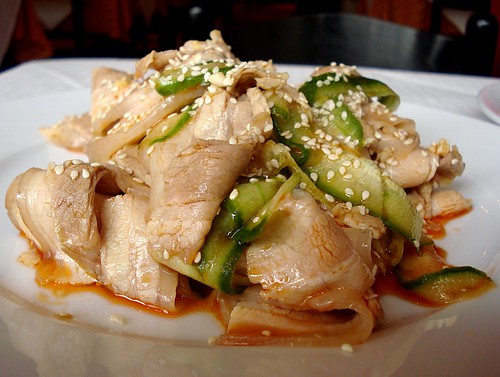
Thin slices of cooked pork intermingled with equally-thin slices of cucumber, piled on a white plate and drizzled with finely-minced garlic in chilli oil.  White sesame seeds are scattered over to finish.

While some Chinese pork dishes, such as 紅燒肉 (hóng shāo ròu/red-cooked pork), require long cooking in a flavourful liquid to get the meat tender and tasty, others are based on the very straightforward procedure of simply boiling the pork in plain water. The result of this is 白肉 (bái ròu) — 白 means plain/white/pure, and 肉 is meat (remember, in the absence of a qualifier, this means pork).

This might not sound overly exciting, but it's actually not too dissimilar to the idea of Western cold cuts — plainly-cooked meat enlivened with some good, strong flavourings. Indeed, the particular dish I'm posting about today is a really tasty one that if done properly will leave you stinking of garlic for some time afterwards.

蒜泥白肉 (suàn ní bái ròu) is a cold dish (涼菜/liáng cài) of sliced pork slathered in a sauce based on mashed/minced garlic (蒜/suàn). There are many, many ways to make this sauce. Eating Club Vancouver has two versions of 蒜泥白肉, one of which grinds the garlic in the blender for a thicker, more homogeneous sauce. Soy sauce is a common ingredient; conversely, the version pictured above was flavoured very simply with chopped garlic in chilli oil.

The sauce I use is adapted from a book I found on Google Books (although it's bilingual inside, it doesn't appear to have an English title — the Chinese title is given as 培梅名菜精選: 川浙菜專輯). It's based on a sweetened soy sauce, which you can make by gently simmering 200ml soy sauce with 150g sugar, 4 Tbsp Shaoxing wine, 1 sliced spring onion, 1 slice of ginger, 1 piece of star anise, and a small piece of cinnamon bark, for 15 minutes. To make enough 蒜泥 sauce for 500g pork, mix 4 Tbsp sweetened soy sauce, 2 Tbsp garlic, 1 Tbsp chicken stock, and 2 Tbsp chilli oil (I use Sunflower's recipe for the chilli oil).

Pork belly is a good cut to use for this, or perhaps shoulder. You want a boneless chunk with the skin left on (and unscored) and a good layer of fat. Don't worry if your piece of pork looks a bit flat before you boil it. The skin will contract very quickly as it starts to cook, changing the aspect ratio — the piece I cooked earlier this week nearly doubled in height after boiling!

For a 500g slab of pork belly, you'll want to gently boil it for around 30-40 minutes in total. If you like, you can blanch, drain, and rinse the meat first and then save the boiling liquid to make stock with. This liquid won't be particularly strongly flavoured on its own, but would work fine in e.g. a soup where you might normally use water, or as the base liquid for a proper stock.

When the pork is cooked, leave it to cool and then slice it as thinly as possible before dressing it with the sauce. Getting nice thin slices is probably the hardest part — some people suggest that running the meat under the cold tap as soon as it's cooked will tighten it up and make this easier.

Just as there are many ways to make the sauce, there are also many ways to serve the final dish. One is to lay the pork slices out on a plate and drizzle the sauce over them. You could also toss the pork with the sauce and arrange it in an artful heap, as pictured above. More elaborate presentations involve rolling the pork slices around slivers of cucumber before topping with the sauce (photo), or draping both pork and cucumber over a wooden frame (photo, corroborating photo). Finally, some people prefer to have the sauce served on the side as a dipping sauce.

Incidentally, Joshua at Cooking The Books suggests another good thing to do with boiled pork belly — pork belly with black vinegar and ginger. I'm not sure what this would be in Chinese, but I'll be keeping an eye out for plausible candidates on menus. Joshua also points out the relevance of the short cooking time — the meat stays relatively firm, which not only helps you cut it into the thin slices required, but also gives a very nice texture when you eat it.

If you have any questions or corrections, please leave a comment (here's how) and let me know (or email me at kake@earth.li). See my introductory post to the Chinese menu project for what these posts are all about.

Syndicate

RSS Atom

Tags

December 2012

S M T W T F S
      1
2345678
9101112131415
16171819202122
23242526272829
3031     

Style Credit

Expand Cut Tags

No cut tags